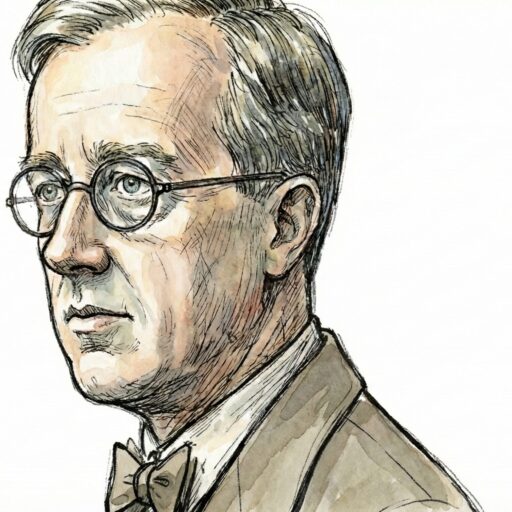
Gustav Holst’s The Hymn of Jesus (written in August 1917) has always been one of his most widely performed works. Its first performance in London in 1920 was an outstanding success; Ralph Vaughan Williams, the dedicatee, said he just ‘wanted to get up and embrace everyone and then get drunk’. Yet perhaps it is taken too much for granted. There remains the mystery why Holst chose to set an obscure Gnostic text in ancient Greek at a time of national catastrophe in the First World War. What was he offering his audience?
A Response to Catastrophe
Undoubtedly, the work is Holst’s artistic and philosophical response to the War; to suffering so intense, and on such a scale, that it was scarcely comprehensible. By 1916 hostilities had reached a pulverising stalemate and conscription had been introduced in Britain. Unlike his friend Vaughan Williams (who had enlisted in 1914) Holst had been denied participation because of his health. The final impetus for producing The Hymn of Jesus may well have been the Battle of the Somme. During five months of 1916, over two million people were slaughtered, including George Butterworth and others of Holst’s friends. Despite a successful Whitsuntide musical gathering at Thaxted, his mood had become edgy and uncharacteristically explosive.(Note.1) Yet far from being elegiac, The Hymn of Jesus – his first major work after completing The Planets – is a very positive and constructive response to suffering.
Holst, as usual, was not forthcoming about his work; his daughter Imogen described his feelings about it as impenetrably reticent, and letters written at this time in his usual chirpy manner give no hint as to his depth of emotion. However, the text he chose to set, and the music that resulted from it, are immensely profound and challenging. The text is worth investigating – not least for the light it throws on Holst’s forgotten performance instructions.
We seem to swim in a different, multi-dimensional musical universe, as past and present come together.
Why, for instance, does he ask that the two mixed choirs be ‘well separated’ (in the Venetian style) -a performing instruction I have never seen observed? Some of the other spatial relationships can best be understood by closer scrutiny of the score. Holst was one of the first composers to explore spatial relationships as an integral part of a work’s structure, and not merely as a quasi-operatic effect. In the Hymn the two mixed choirs are well separated for a very legitimate reason, as will become clear. Two other distant choirs (one of treble voices, the other of tenors and basses) create a curious effect because their music, which is derived from plainsong, creates a sensation of distance in time as well as space. We seem to swim in a different, multi-dimensional musical universe, as past and present come together. This is a more sophisticated development of the spatial ideas that Holst had begun to explore purposefully in Savitri (1908-9) and The Planets (1914-16). In The Hymn of Jesus Holst used another multi-dimensional technique that alters our sense of time and space, that of two musical ideas being played simultaneously at different tempi and in different places (eg. seven bars after fig 2).
The Prelude: A Multi-Dimensional Universe
The work is divided into two sections: a Prelude and the Hymn proper. The Prelude is divided into two halves, the second half being a vocal realization of the material in the first. At the outset the tenor trombone affectingly ‘sings’ the Pange Linguaplainchant. (Holst himself was a professional trombonist for many years, and it is worth remembering that in his day the tenor trombone was altogether softer and sweeter than its powerful modern descendant.) Thereafter the chant is put into a loose harmonic framework of G minor before reaching a new lento idea of intense suffering (Ex.1). This suffering seems to reach a resolution of profound mystery when, in the senza misura bar that follows, double basses and organ pedals, very quietly and very low, play the plainchant Vexilla Regis Prodeunt. Out of which deep, slow, oscillating string chords in fourths and fifths gradually ascend heavenwards over a low pedal bass A. In manner this section is not too dissimilar to the opening bars of Debussy’s La Cathedrale Engloutie.(Note.2) Almost imperceptibly, a distant treble choir enters singing Vexilla Regis Prodeunt three octaves higher. The effect is magical; the music has literally been elevated and shines forth likes stars in the night sky. (‘The royal banners forward go, the cross shines forth in mystic glow.’)The material for the Prelude is derived from the two plainchants Vexilla Regis Prodeunt and Pange Lingua. (Note.3) Both of these Easter chants are to be found in the Sarum Antiphoner and were intended for use in Passion Week. In a harmonized form they had appeared (as Nos.94 and 95) in the 1906 edition of the English Hymnal, for which Holst had contributed some new tunes. It was a modest attempt by the editors (who included Vaughan Williams) to popularize plainsong singing which at that time, like some early music, was beginning to be heard again. A facsimile edition of the Sarum Antiphoner and Gradual had been published by the Plainsong and Medieval Music Society, founded in 1888. It would have been uncharacteristic of Holst not to have looked at original sources, or not to have learned how to sing them properly. Certainly he was not content with the English translations for the plainsongs in the English Hymnal, but went back to the Latin versions written by Bishop Venantius Fortunatus in the sixth century.
When Holst arranged for these plainchants to be sung in their original Latin versions the meaning of the hymns would have been rendered obscure to all except specialists. It can hardly be doubted that this obscurity was deliberate. The presentation of Vexilla Regis by a distant choir of trebles over an orchestra of independently oscillating high chords creates a feeling of an ageless, unknowable, cosmic mystery (Ex.2). The device of two musical ideas sounding simultaneously, but moving at different, independent speeds invites comparison only with Holst’s exact contemporary Charles Ives.
Suddenly the listener is jolted back to a mundane world of suffering by a sharp, piercing chord in the orchestra. This musical indicator of pain, an intensification of Ex.1, is surely an objet trouvee. Christopher Palmer has shown (Note.4) how similar it is to the suffering motif of Amfortas in Parsifal, and the borrowing must be deliberate. Holst thought highly of Parsifal, even going so far as to satirize it in his opera The Perfect Fool. In Wagner’s opera, Amfortas, through his own sin, is a king whose wounds will not heal. His motif has therefore become a symbol for suffering humanity. The Wagnerian allusion must have been intentional, for in composing Saturn (1915) Holst had already written original music capable of evoking the most intense anguish. Such a personal exposition of suffering would have been very appropriate in the Prelude, but Holst seems to want to suggest something else: that humanity as a whole is wounded.
Immediately, from a distant region, the Pange Lingua is intoned by a choir of tenors and basses (Ex.3). Their sound is distinctly ecclesiastical and consolatory as they sing reassuringly of ultimate victory: ‘Sing my tongue the glorious battle, sing the ending of the fray…’. In such similar soothing tones had the trombones uttered this plainchant at the Prelude’s opening. This second half of the Prelude ends in an atmosphere of unearthly resolution and celestial bliss. A bar’s silence allows the listener to absorb the experience. By the end of the Prelude the G minor of the opening has begun to resolve, as from a long dominant pedal, toward C.
The Hymn: A Gnostic Mystery
At this point we could have expected a meditation on the resurrection but what follows is the Gnostic Hymn of Jesus, which exhorts the listener not just to follow Jesus, but to understand why humanity suffers. Holst offered his audience hope through spiritual knowledge. Hence the affirmative, confident and daring setting – as far as is known, the first ever made of a Gnostic text. At a stroke Holst had cast aside the Victorian and Edwardian sentimental oratorio and created the precursor of the kind of works that John Tavener, for instance, was to write in the 1970s.
Since the discovery of a large library of Gnostic texts and mystical gospels in Egypt at Nag Hammadi after World War 2, we now know that the Gnostic church offered a coherent mystery alternative to conventional Christianity (based on the ideals of faith and obedience), interpreting it instead in symbolic terms and offering to unfold a secret doctrine that would lead to true spiritual knowledge (gnosis). This was hardly generally known when Holst encountered the Hymn. Very few Gnostic texts had been published or studied; they were generally classed among New Testament Apocrypha. However one scholar actively engaged in making these texts better known was Theosophist G.R.S.Mead, who was friendly with Holst and had published an edition of the major Gnostic gospel Pistis Sophia (The Testimony of Truth) as early as 1896.(Note.5)
Origins of the Text
In its original form, the Hymn probably dated from the 2nd century or earlier. Despite a call by Augustine for its destruction in the 4th century, when Gnostic Christianity was extirpated as heretical by the Greek and Roman churches, somehow a single manuscript copy managed to survive the vicissitudes of time. This was unearthed in the Imperial Library in Vienna in 1897 and published in 1899 by the Cambridge University Press in Apocropha Anecdota Part 2, edited by M. R. James. In this form it quickly came to the attention of Mead, who gave Holst a copy of the text. Attentive to new scholarly work coming from Europe, Mead had published his own translation of the text in Fragments of a Faith Forgotten in 1900, and in 1907 the Theosophical Publishing Company produced a his translation and commentary on the Hymn as a separate volume. (Note.6) Mead also published a further article in The Quest Vol 2, No 1 (1910) and another exposition of the Hymn in Quests Old and New (1912). Clearly he was fascinated by this text. Why?
The answer seems to be that, according to Mead, it was not a hymn at all in our sense of the word but perhaps the earliest surviving Christian, or indeed pre- Christian, mystery-ritual. Its appeal to Holst was similar to that of the Vedas he had treated in the works of his ‘Indian’ period: not only its authentic message, but its very early date and its origins outside of the distorting effects of the established churches.(Note.7)
Holst may well have come across Mead’s 1907 booklet soon after it was published. On 3 November that year he gave a lecture at Morley College on the origins of modern music during which he mentioned the origins of dance in religion, a subject which deeply interested him and offended others. In his booklet Mead quotes extensively from Philo of Alexandria’s famous descriptive treatise On The Contemplative Life, about the sacred dances and rituals of the Therapeuts in Upper Egypt. (Note.8) In any case Holst was not one to compose in a rush and he laid ideas in store for many years. Clifford Bax (Arnold Bax’s writer brother, who was also a Theosophist) referred to this as Holst’s ‘elephantine gestation’ period.
The tragic events of 1914-16 prompted Holst to find a deeply philosophical and musical response and he looked again at The Hymn of Jesus. Early in 1917 he began to translate the Greek text with the aid of his pupil Jane Joseph (who was later to make the remarkable vocal score), Clifford Bax and G.R.S. Mead. This process, as with translating the Vedas some years before, was musically suggestive to him; it also helped to clarify the meaning of the text. In the end Holst’s translation was quite different from Mead’s published version, much more direct and more rhythmic.
The Ritual of Initiation
Very briefly, according to Mead the ‘hymn’ is a ritual of initiation involving a Master (Jesus?) and his disciples, who form a circle enclosing a would-be initiate in a question-and-answer dialogue. Hence the Holst’s request that the two choirs should be ‘well separated’. Mixed choir 1 represents the Master, mixed choir 2 the initiand. But at the beginning both choirs are united, singing the majestic affirmations ‘Glory to Thee, Father! Glory to Thee, Word!’. Characterized by astonishing, explosive chordal dislocations – C to E major (Ex.4), and C to A flat minor – these outcries are fortified by a large orchestra, including organ and piano, and a walking step bass which allows for harmonic ambiguity. There is also an invocation to ‘Grace’ and the remarkably original spokensetting of ‘Glory to Thee, Holy Spirit’ in which the sounds should span the distance between one mixed choir and the other. After each affirmation the ‘heavenly’ treble choir responds with an ‘amen’ (whereas in the original Greek text it is the assembled disciples who say ‘amen). Sounds are thrown backwards and forwards between each choir, soon reaching a powerful climax at ‘O shadowless light! Amen’. Imagine how overwhelming this would be if the audience were placed in between the two choirs!
The mystery ritual proper begins; a penitent initiand pleads:
Student (Choir 2): Fain would I be saved
Master (Choir 1): Fain would I save
S: Fain would I be released
M: Fain would I release (Note.9)
S: Fain would I be pierced
M: And fain would I pierce
S: Fain would I be borne
M: Fain would I bear
S: Fain would I eat
M: Fain would I be eaten (Note.10)
Urgently, excitedly, the demands of the intiand become more animated as each request is answered immediately by the Master (Ex.5). The two choirs interact with increasing passion, culminating in the Master’s serene ‘I am Mind of all’. (This is one example where Holst’s translation from the Greek is much more direct than Mead’s.) Suddenly all the pent-up energy is released on, ‘Mind’ into a calm pool of pianissimo E major. This E major stasis of Mind (Mead refers to understanding and stability at this point) engenders invigoration, as a 5/4 allegro dance begins in the orchestra. This is a major change: although the music has been impassioned before, has not been vigorous.
The distant trebles lead the dance with ‘Divine Grace is dancing’: it seems to be an answer to ‘fain would I be known’ – in other words, dance is an essential ingredient of the Divine and therefore an essential element in its praise. We know Holst held this view. In this extended section the dance element takes on, at times (beginning at ‘The heavenly Spheres make music for us’), a Bacchic exultancy, a Martian drive Ð recalling The Planets and foreshadowing the Choral Symphony. At its height the choirs sing, in the extreme brightness of C sharp major, ‘Ye who dance not, know not what we are knowing’. The soul must join the dance to attain true Gnosis. ‘Amen’ (‘so be it’) sing the distant trebles.
But the suppliant continues his yearnings to be spiritually set in ‘order’, to be ‘infolded’ or brought within the mystery. In this process there follows fear of loss of home, of resting place and temple, as the initiand yearns for the ultimate experience ofhierogamos and unio mystica. But while in each case the Suppliant’s music is in an agitated 5/4, in each case the Master is reassuring, always answering with composure and authority in 5/2. The dance section reaches a climax in F sharp major in the full orchestra before it dissolves into one of the most striking sections of the whole work: the refulgent proclamation ‘To You who gaze, a lamp am I. To you that know, a mirror. To you who knock, a door am I. To you who fare, the way’ (Ex.6).
Holst’s versions are so much more succinct and memorable than Mead’s published translations. Who was responsible – Clifford Bax, Jane Joseph or Holst himself? All we can be certain about is that the result is the one that satisfied his musical imagination. The extraordinary sound of the downward- sliding chords in the second choir, against the iconic resolve in the first choir, has created one of the 20th century’s astounding musical moments (and this in 1917, in Britain). It shows too, how tremendous musical effects can be simply written. (Holst always had in his mind the technical accomplishments of amateurs.) These moments of assured restraint are understated; despite the luminous discords the music never rises above forte – there is no need of power. Unio mystica has been achieved. From now on the choirs unite and speak with one voice as the Master. They begin to sing ‘Give ye heed unto my dancing. In me who speak behold yourselves’ to the Pange Lingua melody. This is one place, amongst many, which shows how careful Holst was with the rythm of the translated words.
There follows a discourse on the purpose of suffering. This is the philosophical climax of the work, and in order to emphasise it Holst has rearranged the original text so that all the sentences about suffering come together. The Master (Jesus?) was ‘sent to you as a Word’ (Logos), ‘for yours is the passion of man that I go to endure’. The music in the orchestra responds with the sounds of pain and restriction reminiscent of Saturn. But within this there is a sense of release as the bassoon animatedly plays a 12/8 version of Vexilla Regis accompanied by trumpet fanfares. Clearly this is a moment of supreme triumph: for the first time, the trebles of both mixed choirs and the distant choir are united, singing to ‘ah’ the Vexilla Regis plainchant. For a moment the royal banners do seem to pass by as rhythmic percussion, horn fanfares and oscillating orchestral chords create a feeling of triumphant rejoicing.
It is short-lived. The ‘Amfortas’ idea returns and the Master reminds the disciples of the pain involved in personal experience. Mead suggests that here (‘And when ye had beheld it ye were not unmoved’) something ‘of a most distressing nature’ took place in the mystery ritual which ‘unnerved’ the disciples, since it encouraged them to search for wisdom (‘kindled to be wise’).(Note.11) But Holst does not become involved in speculation. Instead, he moves swiftly on to an almost Buddhist position: ‘Learn how to suffer and ye shall overcome’. A sense of ultimate triumph is indicated by the solo trumpet playing the opening of the Pange Lingua. In ‘Behold in me a couch, rest on me’ the luminous discords from earlier in the work have returned. The G major chord has become E flat major and finally a C major maestoso as at the beginning of the Hymn. But musically and philosophically this is not the end. Repeated E major chords alternating (in Holst’s irregular speech rhythms) with C major chords assert that it is only ‘when ye are come to me, then shall ye know: what ye know not will I myself teach you’.
The mystery of life, it seems, cannot be fully understood without the help of a Master (a Jesus?). The distant heavenly choir (‘Fain would I move to the music of holy souls’) brings a faint reminiscence of the 5/4 dance, suggestive of the divine dance of Shiva in Hindu mythology. The sliding chordal dissonances of Ex.6 return at ‘know in me the word of wisdom’, the final ‘m’ being held by closed lips and eventually dissolving into a numinous silence. A recall of the opening affirmations in the earlier chords eventually gives way to reiterated and peaceful ‘amens’ in all choirs. Heaven and Earth have been united. Holst stopped setting at this point in the Gnostic text since, according to Mead, (Note.12), the last sentences provide an alternative ending which must have been drawn from another source.
The musical remoteness of the Prelude is the antithesis of the forthright, declamatory immediacy of the Hymn. This (Ex.4) is ‘here and now’, this is 1917. What Holst offers his audience is not consolation for loss but an unorthodox, philosophical symbol which works on every level, from the literal to the analogical: only by deepening our spiritual understanding can there be an end to suffering. His inspirational music implores us to accept this view. The magnificent construction, the manipulation of musical ideas and the originality of the sounds leave us in no doubt that Holst felt deeply every occult aspect of his remarkable Gnostic text.
Notes
1. Evelyn Edgar, a recalcitrant singing pupil at St Paul’s, recorded Holst’s changing mood in her diary still with the family. 5 June 1916 ‘Gussy was ratty over his last people & vented it on me’; 6 June ‘Gussie was furious’; 15 June ‘I had a singing lesson, he’s most awfully strict nowadays’.
2. Holst, and his friend W.G. Whittaker, knew M.T.J. Gueritte, founder in London in 1907 of the highly influential Societe des Concerts Francais, which instituted an understanding of French music in England for the first time.
3. Vexilla Regis Prodeunt was written by Bishop Venantius Fortunatus in 569 to celebrate the receiving of a relic of the True Cross at St Mary’s Abbey, Poitiers, a gift of the Byzantine Emperor Justin II. It became the marching song of the Crusaders 500 years later. Vexilla was sung on Passion Sunday and until Maunday Thursday when the Blessed Sacrament was carried to the High Alter. Pange Lingua was a Good Friday hymn in the Roman Liturgy. Gounod had used Vexilla in his popular oratorio Redemption, dedicated to Queen Victoria. Jonathan Harvey (an admirer of The Hymn of Jesus) has used both Vexilla and Pangein his Passion and Resurrection (1981).
4. Notes to Chandos CD CHAN 8901, 1990.
5. For more about Mead see Tempo 187 (December 1993), p.17. Holst was never frightened to ask authorities in their field for help. At University College, London he had asked the distinguished historian Romesh Chunder Dutt (1848-1909) who taught Indian history and literature from 1898, for help with Sita (Letter dated ‘Jan 17. 1901’ in the Holst Foundation). He had Sanskrit lessons from Dr Mabel Bode (d.1922) who had been appointed Assistant Lecturer at U.C.L in 1909 and subsequently Lecturer in 1911.
6. Reprinted 1963 (London: John M Watkins).
7. See articles in Tempo 158, 160 and 166 (September 1988).
8. Just as some chorus members had objected to singing Holst’s hymns to Hindu gods so, even as late as the early 1950s, so did Vaughan Williams mention with some disgust that (while rehearsing for a performance of The Hymn of Jesus) some members of the Leith Hill Festival choir had objected strongly to the idea of dance in the Christian religion.
9. According to Mead, saved from the labyrinth of ills and released from the bonds of fate and genesis (The Hymn of Jesus translated with comments by G R S Mead, 1907, pp.37-8).
10. Pierced or wounded so that the knot in the heart might be unloosed and lead to a desire to be re-born spiritually; and a desire to eat the Bread of Life, the Supersubstantial Bread (of the Eucharist), the spiritual nourishment of life (Mead, ibid., pp.38-9).
11. Mead, ibid., p.38.
12. Mead, ibid., p.53.
You can find out more about the author of this article by visiting his website at http://www.raymondhead.com/