
In 1926, Gustav Holst had settled into a Tudor farmhouse at Brook End in Essex, although his restless nature still kept him moving between London and his beloved walking tours of Yorkshire. It was a fascinating time in his life. He was entering a period where he sought to strip his music down to its absolute essentials. While the public still clamored for the rich textures of The Planets, Holst was intellectually moving toward the starker, colder landscapes of Egdon Heath.
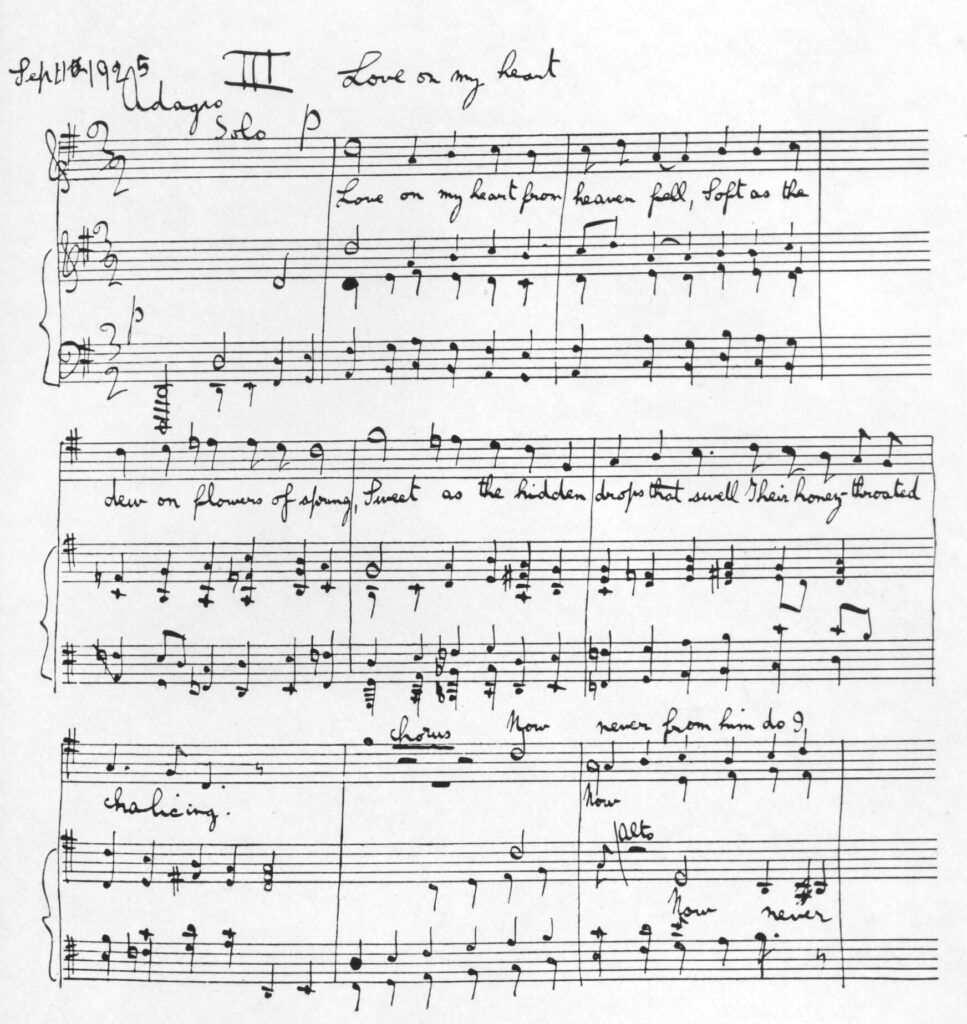
Sitting right on this fault line is a very curious and overlooked work: The Morning of the Year, Op. 45 No. 2.
I find this piece particularly significant because of its place in history. It was the very first work ever commissioned by the Music Department of the BBC. Yet, despite this modern patronage, the heart of the piece remained deeply traditional. Holst dedicated the score to the English Folk Dance Society, continuing his lifelong commitment to music for the community rather than just the concert hall.
Holst intended the work to represent “the mating ordained by Nature to happen in the spring of each year.” I think I read Michael Short call it an English “Rite of Spring.” It was a collaborative effort, a “choral ballet” designed with his friend Steuart Wilson providing the text and Douglas Kennedy designing the dance scenario.
The work is scored for chorus and orchestra, with the chorus acting as the “Voice of Nature” mediating the rituals of the dancers.
To my ear, the opening is the most striking moment. It begins with a summoning horn melody followed by a mysterious evocation of ancient rituals. Biographer Michael Short notes that this section, with its “ghostly pastoral folk-tune echoing an atavistic past,” anticipates the awesome mystery of Egdon Heath, which Holst began sketching shortly after. It is a bridge connecting the “jolly” Holst of the St Paul’s Suite with the “mystic” Holst of the future. When I hear versions of the music, specifically Imogen Holst’s dance arrangements, it reminds me of Star Trek Deep Space Nine!
However, the piece is not without its critics. The Daily News called the premiere “terribly confused artistically,” and even Michael Short has criticized the central “Mating Dance” as being “too bland and folksy, and lacking in any sexual energy.”
Holst himself was annoyed by a press report claiming he thought it was his best work since The Planets. He wrote to the BBC’s Percy Pitt to correct the record, stating rather bluntly: “I certainly don’t [think that]… I did tell one or two men privately that I thought it the best thing I had written during the last two years which is a very different matter.”
The premiere was a broadcast concert performance from the Royal Albert Hall in March 1927, conducted by the composer. The first stage performance followed in June at the Royal College of Music.
The work has suffered from being neither a pure concert piece nor a standard ballet. Without the dancers, the music can seem “unimpressive” to the casual listener. Imogen Holst, the composer’s daughter, later tried to rescue the best music by editing a suite of Dances from the Morning of the Year. She banished the chorus and the “embarrassing” mating synopsis entirely so the music could “lead a life of its own.”
Bibliography
- Holst, Imogen. A Thematic Catalogue of Gustav Holst’s Music. Faber Music, 1974.
- Mitchell, Jon C. A Comprehensive Biography of Composer Gustav Holst. E. Mellen Press, 2001.
- Short, Michael. Gustav Holst: The Man and His Music. Oxford University Press, 1990.