
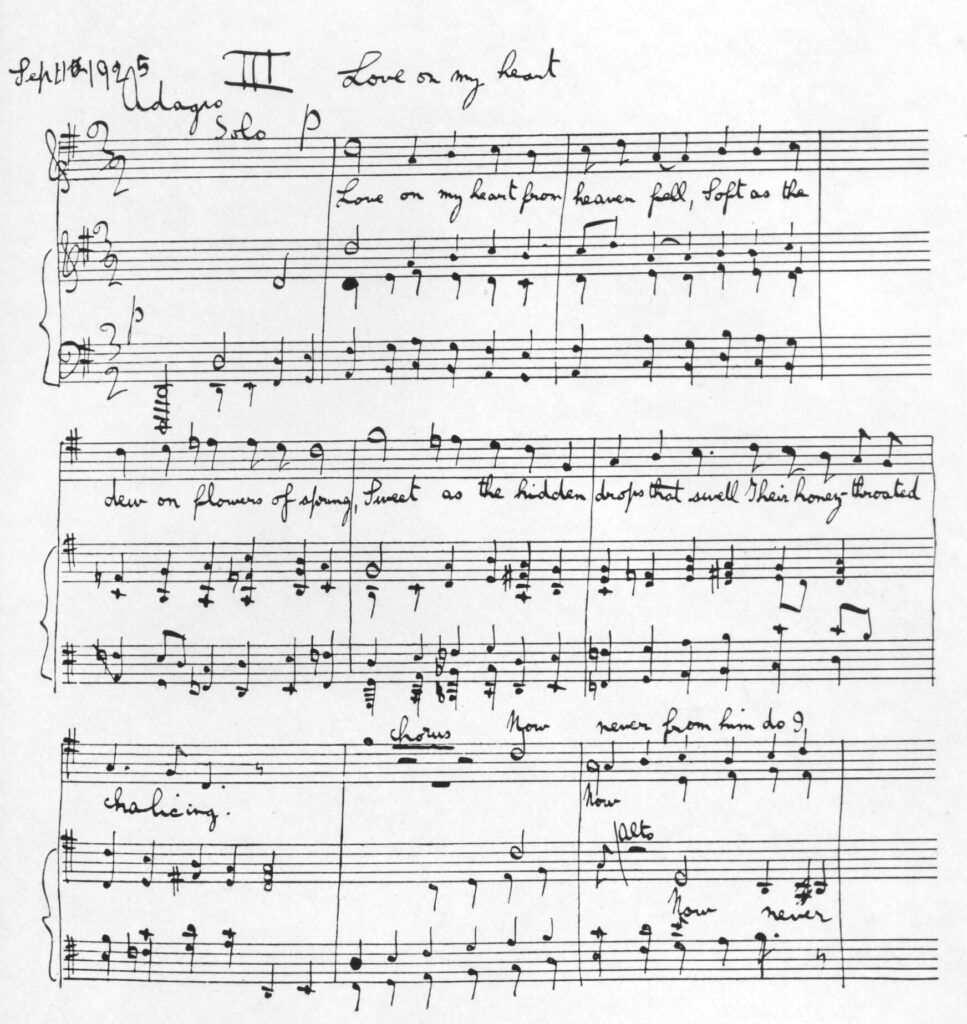
If you wish to understand the heartbreak that paved the way for the cosmic success of The Planets, you must look back to the great stumbling block of Gustav Holst’s career: The Cloud Messenger. This is one of my personal favorite pieces by Holst.
By 1910, Holst was deeply immersed in his “Sanskrit” period. This wasn’t a casual interest in Indian philosophy; it was a fascination that drove him to enroll at University College, London, to learn the language. He could not abide the “stilted” English translations of the Rig Veda then available and was determined to set the texts to his own rhythm. The Cloud Messenger was drawn from the Meghaduta by the 5th-century poet Kalidasa and Holst acknowledged the assistance of R.W. Frazer’s book Silent Gods and Sun-steeped Lands, but the poetic translation was his own, honed over years to ensure the English cadence matched the specific “musical idiom” ringing in his mind.
Musically, the work stands at a fascinating crossroads. It captures Holst with one foot in the 19th century and one tentatively stepping into the future. The shadow of Wagner still looms large here, particularly in the chromatic harmonies which stand in stark contrast to the austere, economical style he was about to develop in works like the Four Songs for Voice and Violin. Similar to The Planets, this is a maximalist score, calling for a “huge orchestra,” organ, and two harps—a lush, immersive texture far removed from his later asceticism.
The narrative is a love story: an exiled poet in Central India induces a passing Cloud to carry a message of love to his lonely wife in the Himalayas. As the Cloud drifts northward, it witnesses various scenes, like temple dances in a holy city and mountain vistas before finally whispering the message into the sleeping wife’s ear. Michael Short has observed that in certain respects, the work is a “return to Sita,” Holst’s earlier unperformed opera, characterized by “gargantuan proportions and Wagnerian tendencies.” Yet, there are glimpses of the Holst to come: the initial entrance of the chorus anticipates the spiritual intensity of The Hymn of Jesus, and the use of descending whole-tone bass scales clearly predicts the “Saturn” movement of The Planets.
Holst poured his soul into this piece. Biographer Jon C. Mitchell notes that Holst admitted the work took him “seven years — seven happy years of course.” He genuinely believed it was the finest thing he had written.
Unfortunately the reaction from critics and audience members wasn’t so great. The premiere, given on March 4, 1913, at the Queen’s Hall under Holst’s own baton (part of a concert series sponsored by his generous friend Henry Balfour Gardiner), was a catastrophe. The reviews were mixed to poor, with critics finding the chromaticism “cloying” and the length cumbersome. The failure devastated Holst. Writing to his friend Frank Duckworth shortly after the concert, he confessed: “The ‘Cloud’ did not go well, and the whole thing has been a blow to me. I’m fed up with music, especially my own.”
And yet, it is one of the great ironies of British music history that without this failure, we would likely not have The Planets. To cheer up the despondent composer, Balfour Gardiner funded a holiday to Spain for Holst and his friends Clifford and composer Arnold Bax. Raymond Head notes that it was on this specific trip that Clifford Bax introduced Holst to astrology. And that spark, ignited in the ashes of The Cloud Messenger, led directly to Mars, Venus, and Jupiter.
Bibliography
- Capell, Richard. “Gustav Holst (Continued).” Music & Letters 8, no. 1 (1927): 73–82.
- Dickinson, A.E.F. Holst’s Music: A Guide. London: Thames Publishing, 1995.
- Evans, Edwin. “Modern British Composers. VI. Gustav Holst (Concluded).” The Musical Times 60, no. 922 (1919): 657-661.
- Head, Raymond. Gustav Holst—The Planets Suite: New Light on a Famous Work.
- Holst, Imogen. A Thematic Catalogue of Gustav Holst’s Music. London: Faber Music, 1974.
- Mitchell, Jon C. A Comprehensive Biography of Composer Gustav Holst with Correspondence and Diary Excerpts. Lewiston, N.Y.: E. Mellen Press, 2001.
- Short, Michael. Gustav Holst: The Man and His Music. Oxford: Oxford University Press, 1990.