
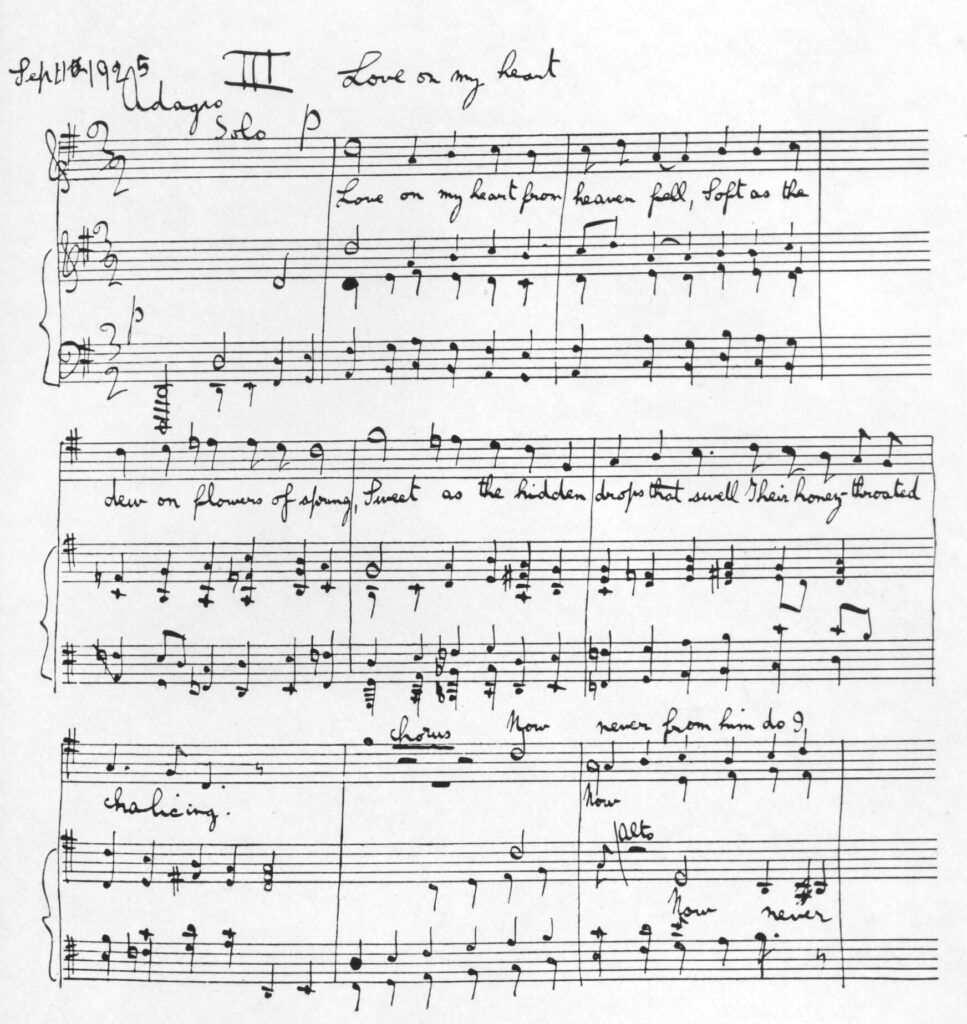
Having moved past his early struggles as a trombone player in touring opera companies, by 1911 Gustav Holst was establishing himself as a dedicated teacher at St Paul’s Girls’ School and Morley College. Intellectually, he was a man straddling two worlds: he was deep into his “Sanskrit” period, having recently completed The Cloud Messenger, yet simultaneously immersed in the English Folk Song Revival.
The Second Suite in F is the direct result of that immersion. Unlike his First Suite in E-flat (1909), which was constructed from original themes, the Second Suite is a love letter to the traditional tunes of the English countryside. The driving force behind the work was the preservation of this fading heritage; specifically, Holst utilized seven songs collected in Hampshire by Dr. George B. Gardiner. While Holst was not a collector himself, he was a brilliant arranger who knew how to frame these melodies without robbing them of their simple dignity.
A Delayed Premiere
It is important to remember that in 1911, the “military band” was often looked down upon by serious composers, relegated to playing transcriptions of orchestral overtures. Holst, along with his friend Ralph Vaughan Williams, was revolutionary in treating the medium as a serious artistic vehicle, attempting to scrub away the influence of German Romanticism to find an authentic “native” voice.
Curiously, despite its quality, the Second Suite in F sat on the shelf for more than a decade. It was not performed until June 30, 1922, at the Royal Military School of Music at Kneller Hall. The manuscript reveals that Holst originally titled the work Fantastic Suite, but later crossed that out. Today, it stands as a cornerstone of the repertoire, though it took years to achieve that status.
Analysis of Movements
The suite comprises four distinct movements:
- March: Far from a stiff military parade, this is a medley of three tunes: “Glorishears” (a Morris dance), “Swansea Town,” and “Claudy Banks.”
- Song Without Words: A setting of “I’ll Love My Love.” This is a stark, lonely melody in the Dorian mode, featuring a tender solo for the oboe (or cornet).
- Song of the Blacksmith: A boisterous, brass-heavy movement featuring a syncopated anvil part. Holst later adapted this music for a male-voice choir setting in his Op. 36.
- Fantasia on the Dargason: The crown jewel of the suite. Here, Holst performs one of his most famous “magic tricks.” He introduces the jig-like tune “The Dargason” (in 6/8 time) and repeats it endlessly… 25 complete statements in total! Just as the listener settles into this cycle, the lower instruments enter with the broad, lyrical melody of “Greensleeves” (in 3/4 time). As Jon C. Mitchell notes, this “skillful juxtaposition” allows two totally different tunes to combine in perfect counterpoint, a feat that displays Holst’s deft orchestration. The movement was so successful that Holst later reused it almost note-for-note as the finale of his famous St Paul’s Suite for strings.
Bibliography
- Holst, Imogen. A Thematic Catalogue of Gustav Holst’s Music. London: Faber Music, 1974.
- Lace, Ian. “Compositions: Suite No. 2 in F.” The Gustav Holst Website, 1995.
- Mitchell, Jon C. A Comprehensive Biography of Composer Gustav Holst with Correspondence and Diary Excerpts. Lewiston, N.Y.: E. Mellen Press, 2001.
- Rapp, Willis M. The Wind Band Masterworks of Holst, Vaughan Williams, and Grainger. Galesville, MD: Meredith Music Publications, 2005.