
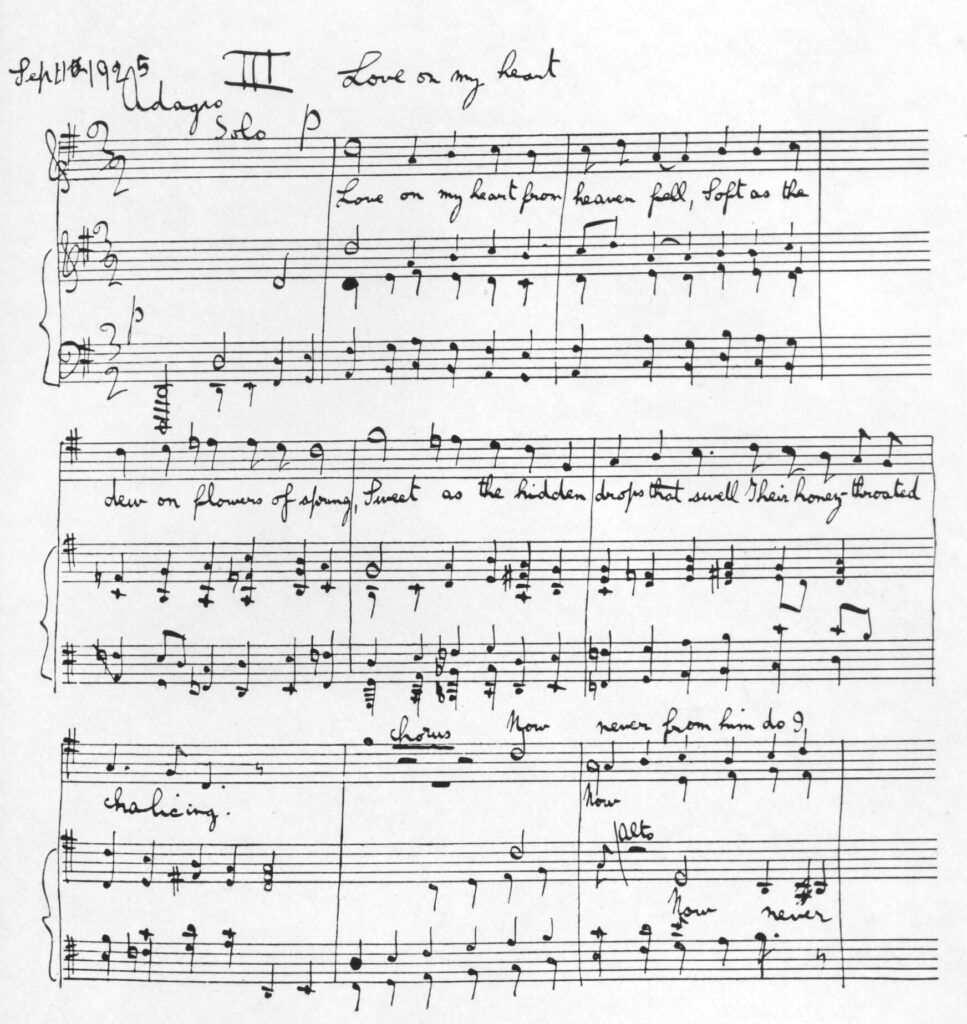
If there is one piece that can claim to be the grandfather of the modern wind band repertoire, it is surely Gustav Holst’s Suite No. 1 in E-flat. Composed in 1909, it was a truly revolutionary work. At that time, military and concert bands were largely fed a diet of orchestral transcriptions—reductions of Wagner or Rossini overtures that treated the band simply as an “orchestra without strings.”
Holst had a different vision. He wanted to make the concert band a serious medium in its own right. With this Suite, he took the first step in that direction, proving that wind instruments possessed their own unique colour and dignity.
Holst was uniquely suited for this task. Unlike many of his contemporaries who composed from the safety of a piano bench, Holst knew life in the trenches. He had played trombone professionally for the Scottish Orchestra and the Carl Rosa Opera Company, gaining an intimate knowledge of what wind instruments could (and could not) do.
Here’s a random detail about his early career that I find… amusing? sad? For seven years, Holst played trombone for the White Viennese Band. This was a seaside ensemble that claimed to be foreign, with members even affecting phony accents to maintain the ruse. In reality, two-thirds of the group were from England. It says a great deal about the “patriotism” of the era that audiences were more likely to pay for a concert by a “foreign” band than a British one. Even the performers were paid more for this than other English forward ensembles!
Holst’s style here differs entirely from the transcriptions of the day. He wrote specifically for the texture of the band.
For me, the genius of the work is evident right from the opening Chaconne. It begins with a melody of 16 notes, stated simply in the euphonium and low brass. As a trombonist in high school, I actually learned how to play the euphonium to play this solo! This theme then weaves its way throughout the entire band. There is a moment in the middle of the movement that is pure academic brilliance disguised as music: the trombone plays the inversion of the theme, yet it sounds completely natural. The movement builds ever so slowly until the finale, marked by a strong fortissimo in all instruments and a sustained chord in the upper winds while the lower brass drops out. It is a spine-tingling moment.
The remaining two movements are actually based on segments of that original Chaconne theme. The Intermezzo is marked vivace and shows Holst’s absolute mastery of the woodwind section. It is light, vibrant, and agile.
The piece concludes with a March in ABA form. What makes this march so interesting is the finale. In a technique Holst would use again in the St Paul’s Suite and the Suite No. 2, he combines his two main melodies in a sophisticated counterpoint. It is such cool complex writing and manages to be both clever and toe-tappingly accessible.
It seems incredible that such a seminal work waited eleven years for its first performance, which finally took place in 1920. Today, it stands as perhaps the single most important work in the wind band canon (well, maybe some Persichetti is up there, too!)
Bibliography
- Mitchell, Jon C. A Comprehensive Biography of Composer Gustav Holst. E. Mellen Press, 2001.
- Short, Michael. Gustav Holst: The Man and His Music. Oxford University Press, 1990.