
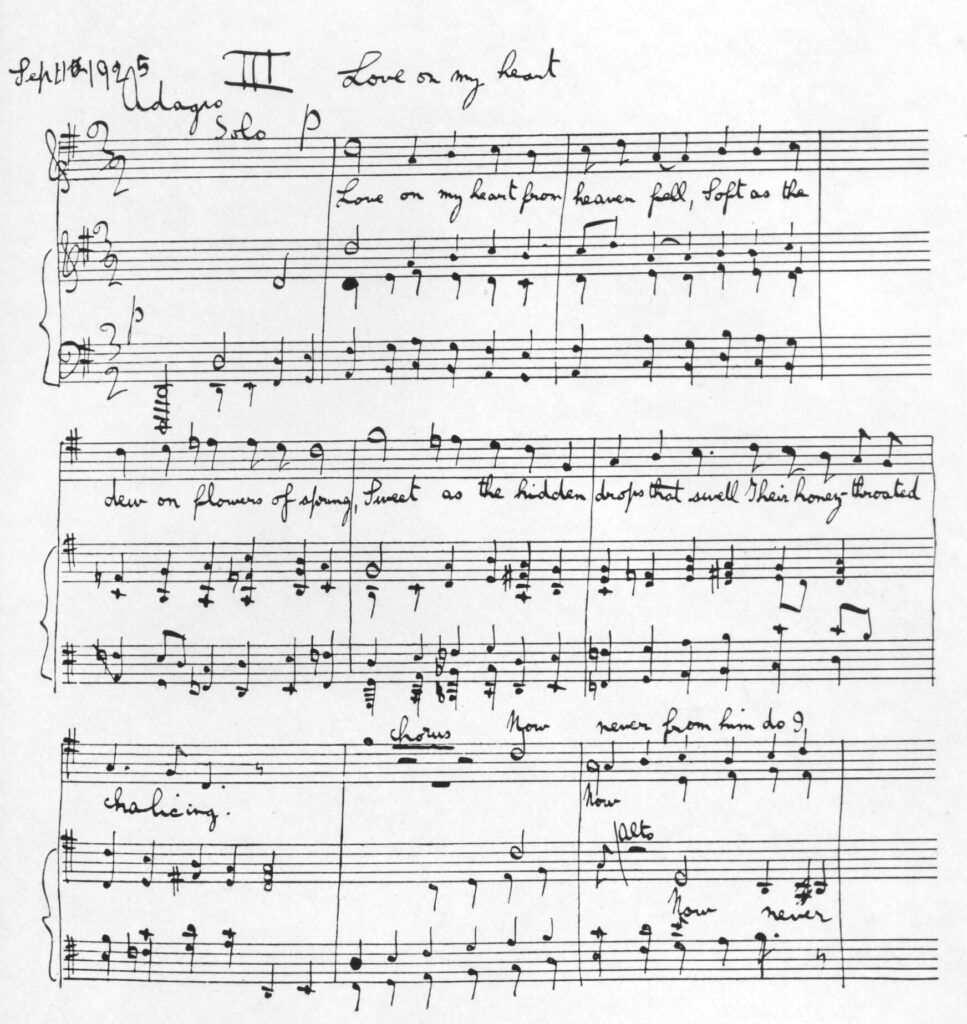
The composition of Savitri in 1908 represents a stylistic shift in Gustav Holst’s output. By the turn of the year, Holst was somewhat at a crossroads, physically exhausted by neuritis and spiritually drained by the failure of his Wagnerian epic Sita to win the Ricordi prize. It took a holiday in Algeria, funded by his close friend Ralph Vaughan Williams, to clear the air. Amidst the white heat of the desert, Holst finally shed the heavy, chromatic “bawling” of his early years. He returned to his new music room in Barnes not to write another grand opera, but to define a new genre of English music: the opera di camera.
The work is a masterclass in economy, scored for a chamber ensemble of merely twelve players: two string quartets, a double bass, two flutes, and a cor anglais. To this spare texture, Holst added a chorus of female voices singing on a wordless vowel, a device that creates a ghostly, atmospheric bridge between the dramatic action and the supernatural elements of the plot. This radical paring down was heavily influenced by the English folk-song revival, which, as Imogen Holst observed, guided her father toward an “emotional restraint” that purged his musical language of excess.
Holst acted as his own librettist, translating the text from the Mahabharata himself to ensure the English rhythms were inextricably linked to the musical line. The narrative is simple and poignant.
The woodcutter Satyavan returns home to his wife, Savitri, only to be claimed by Death. Savitri greets the visitor with the hospitality due a guest, a gesture that prompts Death to offer her a boon—anything but the life of her husband. Her request for the “fullness of life,” including children, creates a logical paradox that Death cannot resolve without restoring Satyavan.
Musically, the work is the first true manifestation of the mature Holst. He employs bitonality to distinguish between the mortal and immortal spheres, most notably in the bass accompaniment which often moves independently of the vocal line. The opera opens with the voice of Death singing completely unaccompanied, a striking, linear gesture that was decades ahead of its time. Holst explicitly stated in the score that the work was intended for performance “in the open air, or else in a small building,” removing the artificial barrier of the proscenium arch to create a direct intimacy between singer and listener.
Though completed in 1908, Savitri had to wait eight years for its premiere, finally reaching the stage on December 5, 1916, at Wellington Hall in St. John’s Wood under the baton of Hermann Grunebaum. Its true artistic vindication came with a production at the Lyric Theatre, Hammersmith in 1921, where the Musical Times hailed it as a “perfect little masterpiece.”
The unique power of Savitri lies in its very intimacy, a lesson I learned firsthand during my undergraduate years. For my senior recital, I undertook the role of Death and staged the entire opera; I don’t think a music major at my college had previously attempted this. The experience was transformative. While Holst’s “minimalist” requirements made the production portable and perfect for our limited resources, the score itself demanded a profound level of concentration. It is not music for amateurs; it forced us as performers to carefully consider our physical presence and how to captivate an audience without the crutch of elaborate staging. Solving the acoustic puzzle of where to place the hidden choir to achieve that ethereal, disembodied sound was a unique challenge. The reception was overwhelmingly positive, proving that Holst’s 1908 vision of a nimble, intimate opera remains as practical and powerful today as ever.
Bibliography
- Cape, Richard. “Gustav Holst: Notes for a Biography (II).” The Musical Times 68, no. 1007 (Jan. 1, 1927).
- Dickinson, A.E.F. Holst’s Music: A Guide. London: Thames Publishing, 1995.
- Holst, Imogen. The Music of Gustav Holst and Holst’s Music Reconsidered. 3rd ed. Oxford: Oxford University Press, 1986.
- Lace, Ian. “A Biography of Gustav Holst.” The Gustav Holst Website (Archive Content).
- Mitchell, Jon C. A Comprehensive Biography of Composer Gustav Holst with Correspondence and Diary Excerpts.Lewiston, N.Y.: E. Mellen Press, 2001.
- Short, Michael. Gustav Holst: The Man and His Music. Oxford: Oxford University Press, 1990.