
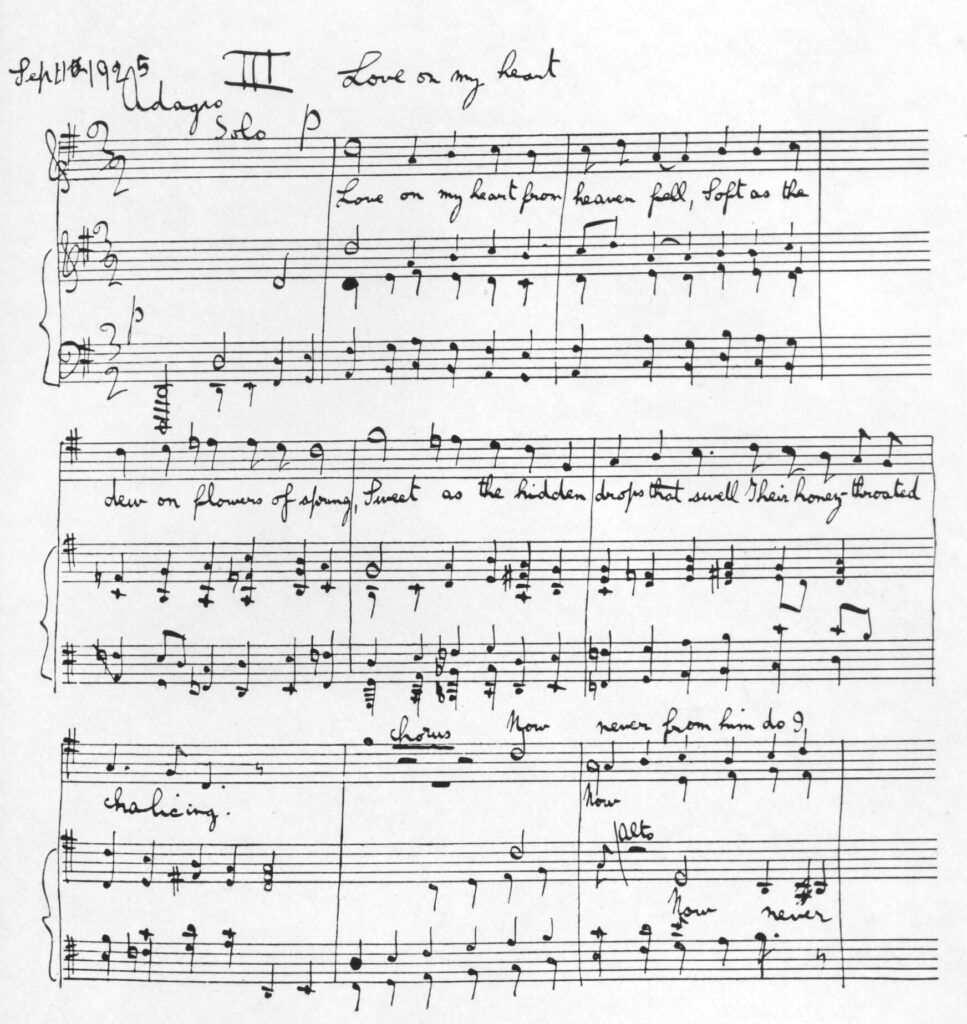
The commission for A Moorside Suite came from the organizers of the National Brass Band Festival, who requested a test piece for their annual championship at the Crystal Palace.
Before achieving fame as a composer, he had earned his living as a professional trombonist, performing in touring opera orchestras and seaside bands. He knew brass instruments from the inside out. Unlike many orchestral composers who looked down on the all-brass format, Holst actually preferred the brass band to the military band (which includes woodwinds). He felt the brass band possessed a more “homogenous tonal blend” that allowed for a mellower, richer sound, distinct from the sharper textures of the military ensemble.
Holst attempted to arrange the entire suite for the junior string orchestra at St Paul’s Girls’ School but remained unsatisfied with the result, writing to his assistant Vally Lasker that “it just won’t do… the obvious truth being that it is not real string music.” This frustration drove him to compose the Brook Green Suite shortly after, seeking a work that was as native to strings as Moorside was to cornets.
However, the Nocturne proved to be the exception to this rule. Its lyrical, sustained quality translated beautifully to the string medium. While the full suite is rarely played by strings, the Nocturne has found success as a standalone piece for string orchestra and has been recorded multiple times, proving that at least one movement could transcend its original medium.
Analysis of Movements
The suite consists of three movements that blend the folk-song simplicity of his early years with the mature harmonic language of his later period:
- Scherzo: The work opens with a skipping 6/8 rhythm. It features a “robust” canon in the trombones and euphoniums—a nod to Holst’s own instrument. It is jagged, agile, and typically Holstian in its nervous energy. Everytime I hear this movement, I think “This is so smart.”
- Nocturne: This is the emotional core of the work. While it bears a striking “family resemblance” to the slow procession of Saturn from The Planets, it possesses a warmth that Saturn lacks. It features a poetic cornet solo and descending thirds and sixths that give the movement a rare, tender quality.
- March: The finale is driven by vigorous melodic fourths. It is “impetuous and fierce” (Dickinson), with the cornets and euphoniums engaging in a sturdy, major-key tune that feels like a traditional folk tune anthem.
The competition took place on September 29, 1928 and the atmosphere was incredibly tense, not only because of the difficulty of the music but because heavy wagers had been placed on the outcome of the competition. In a display of remarkable stamina, Holst sat through fifteen consecutive performances of the suite by different bands. He was deeply impressed by the technical proficiency of the bandsmen, noting that the musicianship far exceeded his expectations. The competition was ultimately won by the Black Dyke Mills Band.
Bibliography
- Dickinson, A.E.F. Holst’s Music: A Guide. London: Thames Publishing, 1995.
- Mitchell, Jon C. A Comprehensive Biography of Composer Gustav Holst with Correspondence and Diary Excerpts. Lewiston, N.Y.: E. Mellen Press, 2001.